Engineering induction · Sample evaluation
How to Test an Induction Wok Range Before Approving an Order
Agree what the sample must demonstrate, then record what actually happens. This checklist helps importers, distributors and kitchen-project buyers connect a cooking trial with an identifiable equipment order.
Quick answer
The decision in brief
- Agree the cooking task, test conditions and acceptance criteria before the demonstration. Leave missing evidence pending.
- Identify the equipment family, selected configuration, nameplate and cookware together. A model code or catalogue picture alone is not enough.
- Carry the observations, unresolved items and approved configuration into the order. A successful sample does not establish every variant's performance or long-term reliability.
Evaluate a shortlisted sample and resolve open items before approving its configuration for an order.
Importers, distributors and kitchen-project buyers serving India and Southeast Asia.
01
Agree what would count as an acceptable result
Begin after the buyer has shortlisted an equipment format. The existing wok range buying guide covers that earlier selection; this article starts with a proposed sample. Describe the recipe, ingredient load, starting conditions, operating sequence and food result that the buyer wants to evaluate.
Agree which observations matter and who will decide. The chef may review the food, the operator the handling, and the project team the installation information. Set any timing or repeat-cycle criteria for the actual task and within the documented operating limits. Do not borrow a batch size or output promise from another model's demonstration.
- Write the task and acceptance criteria before the trial.
- Identify the people responsible for the operating, food-quality and installation decisions.
- Use pass, fail or pending, with a reason for each decision.
02
Identify the sample and its matched wok
Record the product family, exact model and variant, nameplate, supplied instructions, control version and serial reference where available. Link photographs to that record. Confirm whether the sample represents the equipment proposed for the order and record any difference.
A model code can be insufficient: the current LINGSHI single-burner wok and precision-temperature frying records both include the code JD6015-L. Record the product family and functions as well as the code; do not use the shared code to assume identical controls or test scope.
Identify the wok's material, base shape or curvature, working dimensions and intended load. Obtain confirmation for the actual equipment-and-vessel combination. A recorded bowl diameter is not proof that every wok of that nominal diameter will fit. Changing the demonstration wok later requires a compatibility review.
03
Confirm the test setup and operating instructions
Obtain the selected variant's electrical and installation requirements. Have the responsible local electrical professional review the actual supply and connection arrangement. A voltage label alone does not establish phase, frequency, cable, breaker or plug requirements.
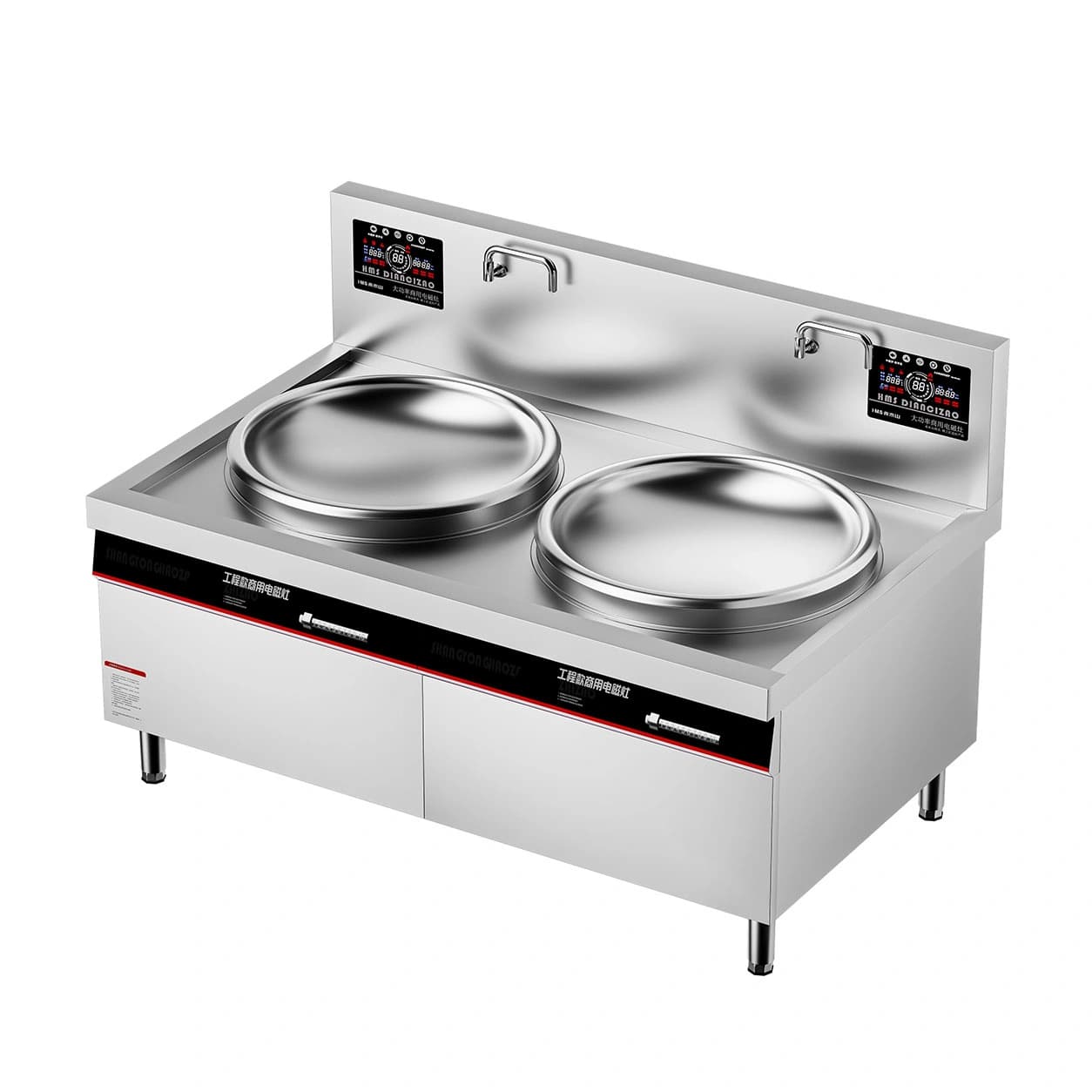
Record the reviewed supply configuration, test location, supporting surface or floor space, ventilation and service-access conditions. For a double-position range, agree whether the task requires both positions to operate together and confirm that the test setup supports the intended operation. One position working alone does not answer a simultaneous-use question.
Follow the supplied operating instructions and use appropriately trained personnel. This is a cooking evaluation. Opening the cabinet, changing wiring, bypassing protection or improvising fault tests is outside the buyer checklist.
04
Record the complete cooking cycle and operator observations
Use the agreed vessel, ingredient quantity and starting conditions. Record the settings, loading sequence, task duration and food result. Repeat the agreed sequence where needed. When conditions change, identify the change instead of combining the readings into one apparently comparable result.
Observe control changes, handling and any displayed messages or interruptions. If the task involves moving or lifting the wok, follow the operating instructions and confirm the expected behavior for the model. Describe what happened and when; do not label every interruption normal or every unfamiliar message a defect without review.
If energy is measured, record the instrument, interval and task boundary alongside the actual reading. Keep the result attached to those conditions. This checklist supplies no energy-saving percentage, production capacity or standard cycle time for a LINGSHI model.
Include cleaning and access in the review
Review the documented shutdown, cooling and cleaning sequence. Check access around the wok seat, controls and external surfaces without exceeding the instructions for water or cleaning products. Exterior appearance does not establish a waterproof rating. An open-bench cooking trial also does not approve an enclosed kitchen installation.
Existing product references
Identify the wok range you want to evaluate
Open the existing models and configurations directly, then attach the selected reference to the sample discussion.View engineering wok ranges05
Keep a sample acceptance record with unresolved items visible
Copy these fields into the buyer's project record. Enter actual observations and link photographs or video to the relevant task. An empty field is pending. A partial video supports only the part of the process it shows.
| Record | What to enter |
|---|---|
| Equipment identity | Product family, model, variant, nameplate, serial reference and photographs |
| Documents | Specification, installation and operating-instruction versions supplied |
| Test setup | Location, reviewed supply configuration, connection and installation conditions |
| Cookware | Vessel reference, material, shape, dimensions and intended load |
| Cooking task | Recipe, ingredients, quantity, starting conditions and agreed criteria |
| Operating sequence | Settings, loading, movement, repeat cycles and simultaneous use if applicable |
| Observations | Food result, task duration, handling, interruptions and displayed messages |
| Measurements | Actual readings, instrument, measurement interval and task boundary; not assumed values |
| Decision | Pass, fail or pending for each agreed item, with reviewer and reasons |
| Follow-up | Required change, responsible person, retest condition and approval reference |
06
Carry the approved configuration and open items into the order
Identify the equipment variant, wok or accessories, instruction versions, agreed inspection points and acceptance record in the proposed order. Keep pending items assigned to a person and a review date or condition. Do not turn a blank item into a pass just because the order is moving forward.
When a control, cookware, supply variant or other relevant specification changes, identify the effect and agree the review or retest needed before shipment. A sample result applies to the combination and conditions recorded; it does not automatically cover all product variants or prove long-term reliability.
Confirm the scope of any factory or pre-shipment checks separately. Keep destination documents and product conformity review explicit. A cooking demonstration and this buyer template do not establish regulatory approval or substitute for the applicable product and destination assessment.
07
Send a request that makes the sample questions clear
Use the existing product pages to identify the single-burner, double-burner or precision-temperature frying family you want to discuss. If the model is still open, describe the task and intended cooking positions. Sample availability, test arrangements, price and delivery terms need confirmation for the enquiry.
Include the buyer role, destination, selected product reference, cookware, recipe and load, site supply information and acceptance questions. Ask which documents and test records can be provided. Keep a requested service or document separate from something the supplier has confirmed.
- Importer, distributor or project buyer; destination and intended site.
- Product family, model or unresolved selection; quantity and cooking positions.
- Cookware, recipe, load, repeat cycle and simultaneous-use requirement.
- Site supply information and required installation documents.
- Acceptance criteria, missing evidence and follow-up responsibilities.
Buyer FAQ
Frequently asked questions
Does a successful sample prove long-term reliability?
It supports the observations recorded during the agreed trial. A reliability claim needs evidence for a stated period and operating conditions; one successful cooking demonstration does not supply that evidence.
Can the same wok and test result cover every model?
Confirm the vessel and configuration for each model concerned. A shared family name, nominal bowl diameter or model code is not proof that the same test covers all variants. Record any additional review or evaluation needed.
Is testing one position enough for a double-burner range?
If the intended task requires simultaneous use, agree a trial that evaluates that requirement within the documented operating limits and a reviewed supply setup. A one-position result alone does not establish two-position operation.
Can the voltage label tell us which plug or circuit to use?
No. Obtain the exact variant's electrical and installation requirements and have the actual site and connection reviewed by the responsible local electrical professional. Do not derive connection specifications from a catalogue image or voltage alone.
What should happen if the approved configuration changes?
Identify the change, assess its effect on the recorded task and compatibility, and agree the review or retest required before shipment. Keep the decision, responsible person and updated configuration with the order record.
Conclusion
Use evidence to narrow the next decision
Approve a traceable combination of equipment, cookware, task and conditions. Use the acceptance record to carry evidence and unresolved items into the order, rather than relying on a catalogue code or a short demonstration alone.
Technical references
Sources and evidence boundaries
The linked LINGSHI product pages identify the equipment families discussed here. The checklist is a proposed buyer workflow, not a completed test report, an offered laboratory service or proof of certification. Sample arrangements and model-specific instructions need confirmation.
- LINGSHI single-burner wok range recordProduct family, catalogue image and model reference; not a completed buyer trial.
- LINGSHI double-burner wok range recordTwo-position product reference; simultaneous operating performance is not established by the picture.
- LINGSHI precision-temperature frying range recordSeparate product function and model reference; no temperature-accuracy claim is inferred for another family.
- Existing wok range buying guideEarlier product-selection context. This article develops the subsequent sample-record and approval task.
Prepare the sample discussion