Technology comparison guide
Commercial Induction vs. Infrared Cooktops: Which Fits Your Kitchen?
A commercial buyer should not choose induction or infrared from one headline claim. The useful comparison starts with cookware, cooking process, control response, residual heat, installation conditions and the way the station will be operated every day.
Quick answer
The decision in brief
- Choose commercial induction when compatible cookware, fast control response and lower direct heating of the cooking surface suit the workflow.
- Choose commercial infrared or ceramic heating when broader cookware compatibility is more important and the team can manage a surface that remains hot after use.
- Do not compare technology names alone. Confirm the exact model, rated electrical data, cookware, installation format and intended cooking cycle before purchase.
Commercial investigation and product comparison before a buyer requests models, samples or a quotation.
Restaurant operators, importers, distributors, kitchen consultants and project buyers comparing electric cooking technologies.
01
Start with how each technology creates heat
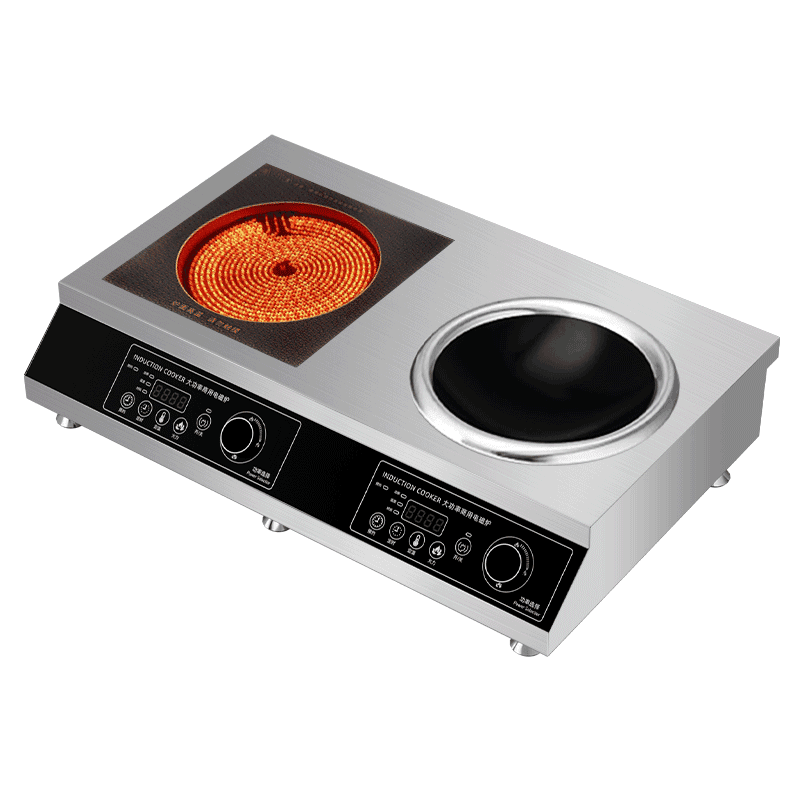
Induction and infrared cooktops may look similar because both can use a glass-ceramic cooking surface, but the heat path is different. An induction system creates an electromagnetic field that causes suitable cookware to heat. The cookware becomes the active part of the heating process. The surface is still warmed by contact with the hot pan, but it is not the primary heat source in the same way as a radiant element.
An infrared or ceramic cooker uses an electric heating element below the surface. That element heats the glass-ceramic area, and the hot surface transfers heat to the vessel. This means the cooker can work with a wider range of heat-resistant cookware, but it also means the cooking zone itself stores more heat. The distinction affects response, cleaning practice, residual-heat management and how an operator handles the pan during service.
For procurement, this first distinction prevents a common documentation problem: a supplier may place induction and infrared products in one catalogue family while leaving the technology unclear at model level. A buyer should require the quotation, specification sheet and product label to identify the heating technology explicitly. Similar appearance is not enough evidence that two models behave in the same way.
02
Compare the factors that change a commercial buying decision
A useful comparison links each technology to the operating condition. Statements such as “induction is better” or “infrared works with everything” are too broad for a commercial project. The right answer depends on what the kitchen cooks, which pans are already standardized, how often vessels are lifted, how the station is cleaned and whether the electrical service matches the selected model.
Cookware compatibility
Induction requires cookware that can couple with the magnetic field. The simplest preliminary check is whether a magnet is strongly attracted to the base, but a purchasing decision needs more than a yes-or-no magnet test. Base diameter, flatness, material construction and the relationship between the pan and the cooking zone can affect operation. Infrared heating is less restrictive about magnetic compatibility, provided the vessel is appropriate for the surface and intended temperature.
Response and residual heat
Induction can respond quickly because power is delivered through the cookware. Infrared equipment heats and cools through the radiant element and surface, so the zone normally retains more heat after the setting changes or the power is turned off. Operators must account for that stored heat when holding, reducing or removing food. The difference is operational, not merely technical: it can change timing, pan movement and the risk of overcooking during a busy service period.
Surface use and cleaning
Both technologies can have smooth surfaces, but cleaning instructions should follow the actual model manual. Spills on a hotter radiant zone may continue to cook onto the surface. An induction surface can also become hot through contact with the pan, so it should never be described as cold or risk-free. Buyers should ask how the surface, control area, ventilation openings and removable parts are cleaned without blocking airflow or damaging seals.
03
Match the technology to the cooking process, not a generic trend
Commercial kitchens rarely use one cooking pattern. A sauce station may require repeated low-to-high adjustments. A soup or stock process may prioritize stable heating with heavy vessels. A hot pot dining table may prioritize cookware flexibility, guest interaction and a built-in format. A wok station adds the geometry of the vessel and the way the cook moves it. These workflows create different equipment questions even when the products share a similar exterior.
Write a short process description before requesting a quote. Include the food category, pan or pot material, base diameter, typical batch size, whether the vessel is lifted or tossed, and the number of operating hours or service cycles expected. Do not convert this information into a guessed wattage. Let the supplier respond with available configurations, then compare the response against the site conditions and the operator’s real workflow.
- Cooking method: boiling, simmering, sautéing, stir-frying, holding or table service
- Cookware: material, base shape, base diameter and loaded weight
- Operation: continuous production, intermittent service or guest-controlled use
- Movement: stationary cookware, frequent lifting or active wok handling
- Cleaning environment: spills, grease, steam and access to ventilation openings
04
Confirm installation and electrical conditions before comparing prices
A commercial electric cooktop is part of an electrical and kitchen system. The project team should confirm available voltage, phase, frequency, circuit capacity, connection method, grounding, clearance, ventilation and the support surface before approving a model. These requirements are model- and market-specific. A generic blog should not prescribe cable sizes, breakers or protective devices for an unknown product and jurisdiction.
Ask for the current model specification sheet and installation instructions, then have a qualified local professional compare them with the site. For a built-in cooker, also confirm cut-out dimensions, access for service, airflow paths and how heat will leave the enclosure. For countertop or floor-standing equipment, confirm stability, usable working height, cord or terminal position and the route for cleaning around the unit.
Price comparisons made before this review can be misleading. A lower equipment price may not remain lower if the site requires electrical changes, a different table, new cut-outs or replacement cookware. Conversely, an apparently more expensive configuration may fit the existing workflow with fewer changes. The procurement comparison should therefore include readiness costs and installation risk, not only the unit price.
- Destination country and installation jurisdiction
- Available voltage, phase and frequency at the exact equipment position
- Dedicated circuit and protective-device requirements from the model manual
- Countertop, floor-standing or built-in installation
- Air intake, exhaust and service-access clearances
- Local ventilation, fire, electrical and foodservice requirements
Configuration checkpoint
Send the cookware and installation details before choosing the technology.
LINGSHI can review the available commercial induction and infrared product directions against your application, cooking positions and site power information.Send your requirements05
Use a sample test to turn the comparison into evidence
When the order value or project risk justifies it, a controlled sample evaluation is more useful than a brochure comparison. Use the intended cookware and a repeatable cooking task. Record the input conditions, control settings, time sequence, operator observations and any alarms. The goal is not to create a universal laboratory claim. It is to determine whether a specific model and pan combination behaves consistently enough for the buyer’s application.
A factory testing discussion should be equally specific. Ask which checks are performed on the selected model, at which stage, under what conditions and what record can be supplied. Depending on the product and agreement, relevant evidence may include functional checks, control response, fan operation, alarm behavior, power-setting verification, leakage or withstand-voltage testing, appearance inspection and a run test. Do not assume that every factory uses the same sequence or that a test name guarantees the same method.
A practical comparison protocol
Test both technologies with a defined vessel and food or water load, using safe procedures and the manufacturer’s instructions. Compare controllability, recovery after a setting change, behavior when the vessel is moved, residual surface heat, fan noise, cleaning access and operator acceptance. Keep results tied to the exact model and conditions. A single demonstration should not be presented as proof for an entire product category.
- Identify model, serial or sample reference and software version where applicable
- Record cookware material, size, shape and load
- Use the same operator sequence and measurement points
- Note ambient conditions and electrical supply
- Photograph or video the setup only with permission and accurate labels
06
Keep technology identity clear during shipment inspection
Induction and infrared models can be visually similar, which creates a preventable shipment risk when several configurations share packaging. The purchase order, packing list, carton label, product nameplate and inspection checklist should use an unambiguous technology description. Model references, quantities, accessories and cookware supplied with the order should match the approved documents.
A pre-shipment inspection can sample appearance, identification, basic function, included parts, packaging and marks according to the agreed plan. Electrical safety or performance claims should be checked through appropriate records and competent testing, not inferred from a brief power-on demonstration. If the buyer uses a third-party inspector, provide the approved specification, golden sample or signed reference, defect definitions and sampling instructions before the inspection date.
- Technology and model match the purchase order
- Nameplate electrical data match the approved specification
- Correct surface format, controls and installation version
- Agreed cookware, accessories and documents are present
- Packaging protects the glass, controls, edges and ventilation areas
- Inspection findings are linked to unit or carton references
07
Send an RFQ that allows a meaningful recommendation
A supplier cannot responsibly recommend induction or infrared from the words “restaurant cooker” alone. A good RFQ provides enough context to identify the product family and the questions still open. It does not need to contain a finished specification, but it should prevent assumptions about cookware, site power and installation.
Ask the supplier to separate confirmed data from optional or pending data. The reply should identify the proposed technology, installation format and model status, then state which details require confirmation. This structure is more useful than a quotation that fills every field with an unsupported standard value.
- Application, menu and cooking process
- Cookware material, base shape and dimensions
- Countertop, floor-standing or built-in preference
- Number of cooking positions
- Destination, voltage, phase and frequency
- Required quantity and target project timing
- Required documents, packaging and inspection expectations
08
A simple final selection framework
Choose the technology by eliminating mismatches. If the existing cookware cannot work with induction and replacement is not practical, infrared may deserve closer review. If fast power changes and a lower directly heated surface fit the process, induction may be the stronger starting point. If the installation enclosure cannot provide the required airflow or the electrical supply does not match the proposed model, neither option should move forward until the site issue is resolved.
Then compare actual models within the remaining technology. Review the specification sheet, installation document, sample behavior, service access, control design, cleaning requirements and supplier evidence. The decision should be traceable: a buyer should be able to explain why the selected configuration fits the cookware, process and site rather than simply saying it was the most powerful or the least expensive.
Buyer FAQ
Frequently asked questions
Is induction always better than infrared for a commercial kitchen?
No. Induction can offer fast response and direct heating of compatible cookware, while infrared can accept a broader range of suitable cookware. The better choice depends on the cooking process, pan material, installation and site electrical conditions.
Can every stainless-steel pan work on an induction cooker?
No. Stainless-steel construction varies. Confirm magnetic compatibility, base size and flatness with the specific cooker. A magnet test is a preliminary screen, not a complete product-compatibility test.
Does an induction surface stay completely cold?
No. The surface is not heated in the same way as a radiant element, but it can become hot through contact with the cookware. Follow the model’s residual-heat indicators and safety instructions.
Is infrared the same as an induction cooker?
No. Infrared or ceramic equipment heats an element and surface that transfer heat to the vessel. Induction uses an electromagnetic field to heat compatible cookware. The technologies should be identified separately in quotations and specifications.
Which technology is suitable for a hot pot restaurant?
Both may be possible. Confirm cookware compatibility, guest operation, built-in or countertop format, table construction, controls and electrical supply before selecting a model.
What should I test before placing a bulk order?
Test the proposed model with representative cookware and a defined cooking cycle. Confirm controls, alarms, vessel behavior, cleaning access, installation requirements and the factory or shipment records agreed in the purchase specification.
Conclusion
Use evidence to narrow the next decision
Commercial induction and infrared cooktops solve different operating problems. Induction is not defined only by speed, and infrared is not defined only by cookware flexibility. The decision becomes clearer when the buyer documents the cooking task, vessel, movement, cleaning environment, installation format and electrical conditions.
Use that information to request a model-level recommendation and evidence. Keep the technology name explicit from quotation through shipment inspection, and treat any unconfirmed parameter as an open item. This approach produces a more defensible shortlist and a more useful supplier conversation.
Technical references
Sources and evidence boundaries
These sources support general technical explanations. They do not certify any LINGSHI model or replace model-level documentation, local codes or qualified installation advice.
- U.S. Department of Energy — Making the Switch to Induction Stoves or CooktopsReference for the induction heating mechanism and general energy-transfer explanation.
- ENERGY STAR — Commercial Electric Cooktops Version 1.0 Draft 1Draft reference for commercial electric cooktop and induction cooktop terminology; not used as a certification claim for LINGSHI products.
Next step