Commercial countertop selection
3.5 kW, 5 kW or 8 kW: Which Induction Cooker Fits?
Start with the cooking task and the customer's site, then compare power options. This guide helps importers, distributors and kitchen-project buyers shortlist three documented LINGSHI series without treating a higher wattage as proof of a better result.
Quick answer
The decision in brief
- Eliminate models whose footprint or documented electrical requirements cannot be supported at the site. Compare the remaining candidates with the intended cookware and cooking cycle.
- The DC 3.5 kW, U 5 kW and U 8 kW records differ in body dimensions and listed supply options. Confirm the exact flat-top or concave SKU before ordering.
- Choose from measured task results and total purchase requirements. The rating alone does not establish batch capacity, daily energy use or plug compatibility.
Compare power, body size and site requirements before choosing models for a sample, project or distributor range.
Importers, distributors and commercial kitchen-project buyers, including those serving India and Southeast Asia.
01
Compare rated wattage across the documented models
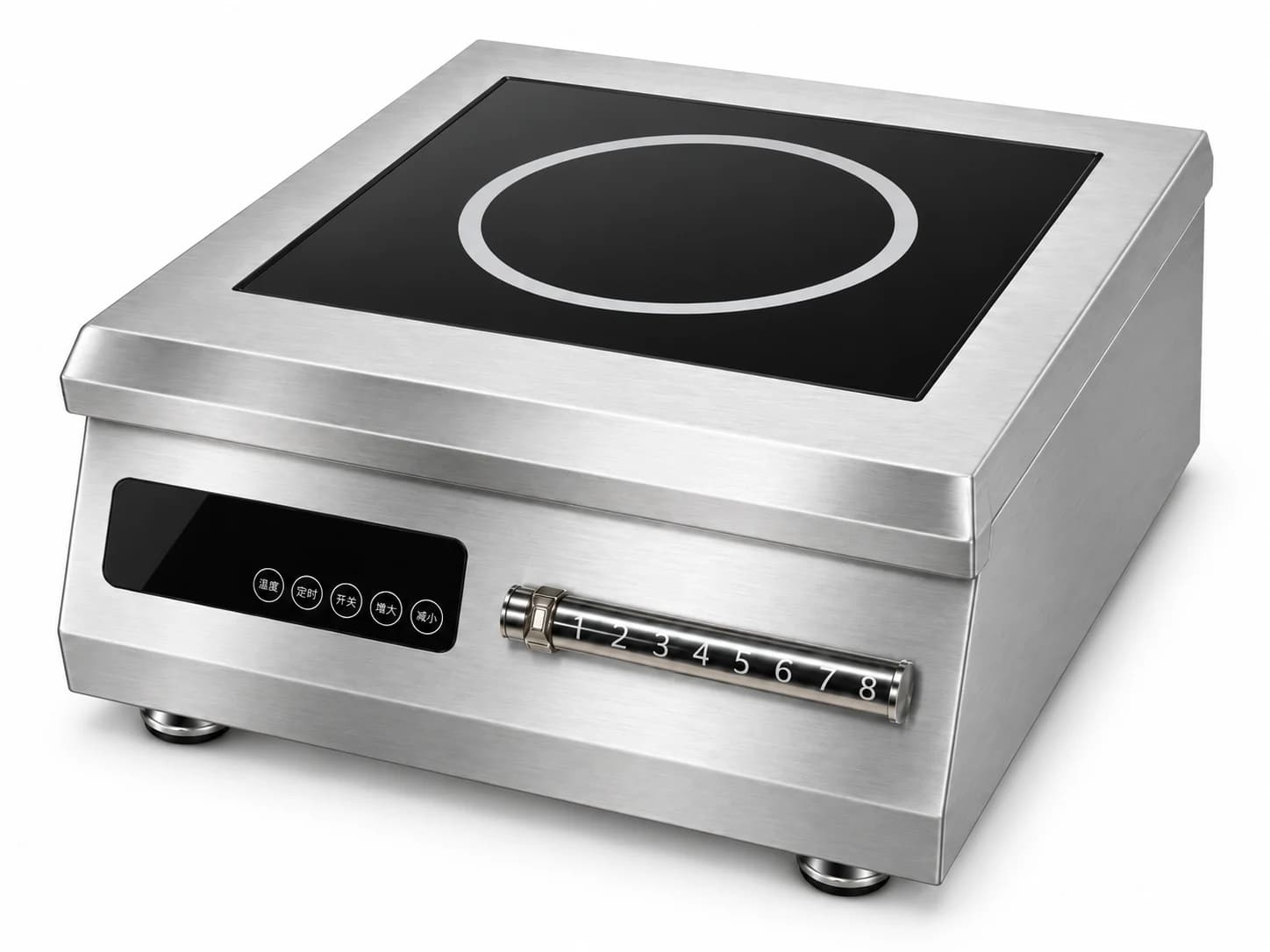
The three product pages below provide a concrete starting point. Each includes flat-top and concave configurations. The dimensions shown are the appliance body dimensions recorded for those configurations, rather than cookware limits or installation clearances.
3.5 kW, 5 kW and 8 kW correspond to 3500 W, 5000 W and 8000 W. These are power ratings, not measured energy consumption over a kitchen shift. Open a product reference to review its selected configuration and images.
| Product reference | Rated power | Flat / concave body dimensions | Listed voltage |
|---|---|---|---|
| DC Series 3.5 kW | 3.5 kW | Flat: 435 × 355 × 150; concave: 435 × 355 × 155 | 220 V |
| U Series 5 kW | 5.0 kW | Flat: 500 × 400 × 240; concave: 500 × 400 × 250 | 220 V |
| U Series 8 kW | 8.0 kW | Flat: 630 × 520 × 285; concave: 630 × 520 × 305 | 220 V / 380 V; confirm the ordered variant |
02
Turn the kitchen's request into a repeatable cooking task
Ask what the customer cooks, how much enters the vessel at once and how often the task repeats. Record the cookware and the required result. A sauce reduction, a repeated boiling task and active wok cooking create different evaluation questions; none can be assigned a suitable wattage from its name alone.
Use the table to compare space first. The recorded DC body is smaller than the two U Series bodies, but a smaller footprint does not prove the required cooking output. If several models fit the site, test the same agreed task on suitable candidates rather than selecting the largest number by default.
- Record the menu item, starting load, vessel and acceptable end result.
- Describe the repeated cycle and the other equipment used at the same time.
- Agree what would pass or fail before comparing sample results.
03
Match the cooking surface and cookware separately
Induction heating depends on compatible cookware. A flat-top reference and a concave wok reference describe different surface geometry; they do not prove that an existing vessel will work with either configuration.
Send the cookware material, base shape, diameter and intended load for model-specific confirmation. For a wok, include its curvature and how it will be moved during cooking. The plate or bowl dimension in a product record is not an established maximum cookware size.
Keep induction and infrared models separate in the distributor catalogue. A similar exterior or glass-ceramic surface does not establish the heating technology. The related technology guide below explains that earlier decision; this guide compares the induction power options after it.
04
Review supply and installation before promising a fit
Countertop describes placement. It does not mean that a model can use any existing socket or that every voltage option shares the same connection. Obtain the selected model's electrical and installation requirements and have the responsible local electrical professional check them against the actual site.
Collect site voltage, phase, frequency, available circuit capacity and the planned simultaneous load. Also confirm the supporting surface, working height, loaded weight, ventilation clearances and access for cleaning and service. Do not derive cable, breaker or plug specifications from this comparison table.
For India and Southeast Asian enquiries, identify the destination and the installation site separately. A country name alone does not establish the site's supply, the customer's import requirements or the documents needed for the ordered configuration.
Model references
Open the countertop models that fit your shortlist
Review the existing product records and configurations before preparing the enquiry.Compare countertop models05
Measure power consumption for the agreed cooking task
Use agreed starting conditions, load and compatible cookware. Record settings, task duration, the result and repeated cycles where needed. If candidates require different vessels, record that difference rather than presenting the results as a controlled comparison.
Power is expressed in kW; electrical energy used over time is expressed in kWh. For an operating-cost comparison, record measured kWh for the agreed trial and apply the customer's actual tariff. A nameplate rating multiplied by assumed service hours is not a measured consumption result.
Keep equipment price, cookware, site work and support arrangements as separate comparison items. A higher rating does not establish better throughput, while a lower rating does not establish lower cost for every completed cooking task.
06
Give every stock item a documented purpose
For each proposed SKU, retain its task description, sample record, confirmed cookware, supply variant and body dimensions. Sales staff can then ask for the missing information when a customer wants a different vessel or installation.
Choose opening quantities from your enquiries and evaluation results. This guide does not establish a standard stocking ratio for 3.5, 5 and 8 kW models across India or Southeast Asia. Review requirements for the actual buyers before committing to quantities or a regional product promise.
07
Send an enquiry that can produce a useful model shortlist
State whether you are comparing samples, preparing a kitchen project or planning a distributor range. Open the linked product page directly if you already have a model in mind; its existing configuration and quantity controls can carry the selection into the enquiry form.
If the model is still open, use the checklist below in your enquiry. Request the model-specific specification and installation information, then confirm packaging, required destination documents, price and delivery terms for the order.
- Buyer role and destination: importer, distributor or project purchaser; country and site.
- Task and cookware: food, load, cycle, vessel material, shape and dimensions.
- Site: supply details, simultaneous equipment load, counter space and clearances.
- Selection: model or power candidates, flat-top or concave surface, and quantity.
- Order review: sample needs, packing, documents and commercial questions to confirm.
Buyer FAQ
Frequently asked questions
What wattage should I choose for a commercial induction cooker?
Shortlist the documented 3.5, 5 and 8 kW options against the intended task, cookware, available space and supported supply variant. A higher rating alone does not establish better cooking output or a better purchase. Use an agreed sample evaluation to decide between suitable candidates.
Can a 3.5 kW commercial cooker use any normal socket?
Do not assume this from the power or voltage label. Obtain the requirements for the ordered model and have the actual connection and circuit checked by the responsible local electrical professional.
How much power does a commercial induction cooker consume?
The rated wattage does not establish actual consumption over a cooking cycle. Five kWh would correspond to a constant 5 kW draw for a full hour; a 5 kW rating alone does not show that the appliance draws that power continuously. Measure kWh for the agreed task and use the customer's actual tariff when comparing cost.
Can I use the same wok on all three power options?
Confirm the material, diameter, base shape or curvature for each selected model. A family label or a matching-looking surface is not a compatibility result.
What should an importer send before requesting a quotation?
Send the destination, intended buyers or project, cooking task, cookware, site supply, surface preference and quantity. Include any model or SKU already selected and the documents required for review.
Conclusion
Use evidence to narrow the next decision
Narrow the choice in this order: cooking task, cookware, site fit, repeatable trial, then the complete purchase requirements. The 3.5, 5 and 8 kW labels identify options to evaluate; the selected SKU and its evidence should determine the order.
Technical references
Sources and evidence boundaries
The linked LINGSHI pages supply the model records used here. EIA and ENERGY STAR support only the general energy-unit and cookware explanations. These references do not establish certification, local approval or tested performance for a LINGSHI model.
- LINGSHI DC Series 3.5 kW product recordSource for the recorded power, voltage and flat/concave body dimensions.
- LINGSHI U Series 5 kW product recordSource for the recorded power, voltage and flat/concave body dimensions.
- LINGSHI U Series 8 kW product recordLists 220 V / 380 V; confirm the supply variant for the actual order.
- EIA — Measuring electricityGeneral definitions of power, watts and electrical energy over time; no model-specific test result.
- ENERGY STAR — Electric Cooking ProductsResidential reference used only for the general induction/cookware principle. No ENERGY STAR certification or residential performance figure is claimed for these commercial models.
Prepare your enquiry